
If you’ve been exploring options for replacing missing teeth, you’ve probably come across All-on-4 dental implants and traditional dentures. Both can restore your smile and your confidence, but they work very differently, and the choice between them has real consequences for your comfort, your daily life, and your wallet over time. So let’s look at both honestly and help you figure out which direction makes more sense for you.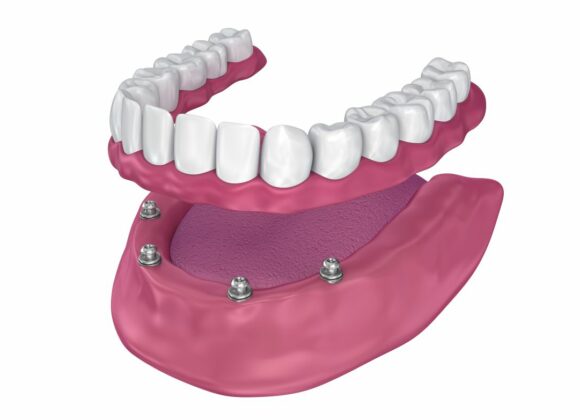
What Are All-on-4 Dental Implants, Exactly?
All-on-4 is a full-arch tooth replacement system. Four titanium implant posts are placed into the jawbone at specific angles, and a complete set of prosthetic teeth is attached on top. The result is a fixed, permanent-feeling set of teeth that stays in your mouth around the clock. You don’t remove them at night, you don’t use adhesive, and they function much like natural teeth.
At our Northgate office, Dr. Ajwant Goraya provides All-on-4 implants as a full-mouth solution for patients who have lost most or all of their teeth, or who are facing significant tooth loss. Patients come to us from across Seattle, Shoreline, Ballard, Fremont, and surrounding areas looking for something more stable and more permanent than what traditional dentures can offer.
Traditional Dentures: Still a Valid Option for Some
Conventional dentures are removable prosthetics that rest on the gum line. They’ve been around for a long time, and for good reason: they’re generally less expensive upfront, require no surgery, and can be made relatively quickly. For patients who are not candidates for implant surgery or who prefer a non-surgical path, dentures remain a reasonable choice.
That said, they come with well-known limitations. They can slip or shift while eating and speaking. They require adhesives to stay in place for many wearers. Over time, as the jawbone naturally shrinks without tooth roots to stimulate it, dentures need to be relined or replaced. Many patients find them uncomfortable after the first few years.
The Long-Term Investment Question
This is really where the comparison gets interesting. Traditional dentures tend to look more affordable at first glance, but the costs don’t stop at the initial fitting. Relining, repairs, replacements every several years, adhesive products, and the ongoing adjustments all add up. Over a decade or two, the total expense can be substantial.
All-on-4 implants require a larger investment upfront, there’s no getting around that. But the implant posts themselves are designed to last a lifetime with proper care. The prosthetic arch attached to them may need attention over the years, but the structural foundation typically does not. When you factor in the long-term costs of dentures alongside the quality-of-life differences, many patients find that All-on-4 delivers better value over time, not just a better experience day to day.
We also want to be straightforward about finances because we know cost is a real consideration. We accept most major insurance plans, and we offer CareCredit as well as flexible payment options to help spread out the cost of larger treatments like this one. Our goal is to make sure cost doesn’t automatically take a great solution off the table for you.
Bone Health and How It Affects Your Face Over Time
One thing that doesn’t always come up in the denture conversation is bone loss. When natural teeth are gone, the jawbone no longer receives stimulation from chewing. Without that stimulation, it gradually resorbs, or shrinks. Traditional dentures sit on top of the gums and do nothing to prevent this process.
Dental implants, by contrast, are anchored in the bone. They mimic the function of natural tooth roots, which helps preserve bone density and maintain the natural shape of your jaw and face. Patients on long-term dentures often notice a sunken appearance around the mouth over time. That’s largely a consequence of bone loss, and it’s something All-on-4 can help prevent.
Which One Is Right for You?
For many patients we see in Seattle and the surrounding neighborhoods, All-on-4 is genuinely the stronger long-term choice, provided they’re good candidates for the procedure. Health factors, bone density, and personal preferences all play a role, and we take all of that into account before making any recommendation. We never push a treatment that isn’t right for the person sitting in the chair.
If you’re on the fence, the best starting point is a conversation and a proper evaluation. If you’d like to explore whether All-on-4 dental implants might be the right fit for you, please give us a call or drop us an email. We’re happy to answer questions and help you think it through at your own pace.
